
Building on years of collaboration Rutgers, Duke, and Columbia Engineering have been awarded a new $3.8 million NSF grant for COSMOS³, a project to expand and enhance New York City’s urban wireless testbed in West Harlem, enabling research in the areas of 6G wireless networks, smart cities, edge AI, and optical networking.
By Xintian Tina Wang
Building on years of collaboration Rutgers, Duke, and Columbia Engineering have been awarded a new $3.8 million NSF grant for COSMOS³, a project to expand and enhance New York City’s urban wireless testbed in West Harlem, enabling research in the areas of 6G wireless networks, smart cities, edge AI, and optical networking.
Columbia Electrical Engineering Kenneth Brayer Professor Gil Zussman and Professor of Professional Practice Zoran Kostic, in collaboration with Rutgers University and Duke University, have received a $3.8 million National Science Foundation (NSF) grant to expand and sustain the COSMOS testbed, an advanced wireless platform that enables cutting-edge experimentation in next-generation networks and smart city technologies, which is being deployed in West Harlem.
The new project, titled “COSMOS³: Enhancing and Sustaining the COSMOS Platform,” is led by Rutgers University’s Ivan Seskar and Dipankar Raychaudhuri, along with Zussman and Kostic and Tingjun Chen, a Columbia Engineering alumnus MS’14, PhD’20. Chen, who studied electrical engineering, is now a faculty member at Duke. Together, the team aims to extend the COSMOS testbed, which was launched in upper Manhattan in 2018 as part of the NSF’s Platforms for Advanced Wireless Research (PAWR) program. The new project is supported by the NSF Community Infrastructure for Research in Computer and Information Science and Engineering (CIRC) program.
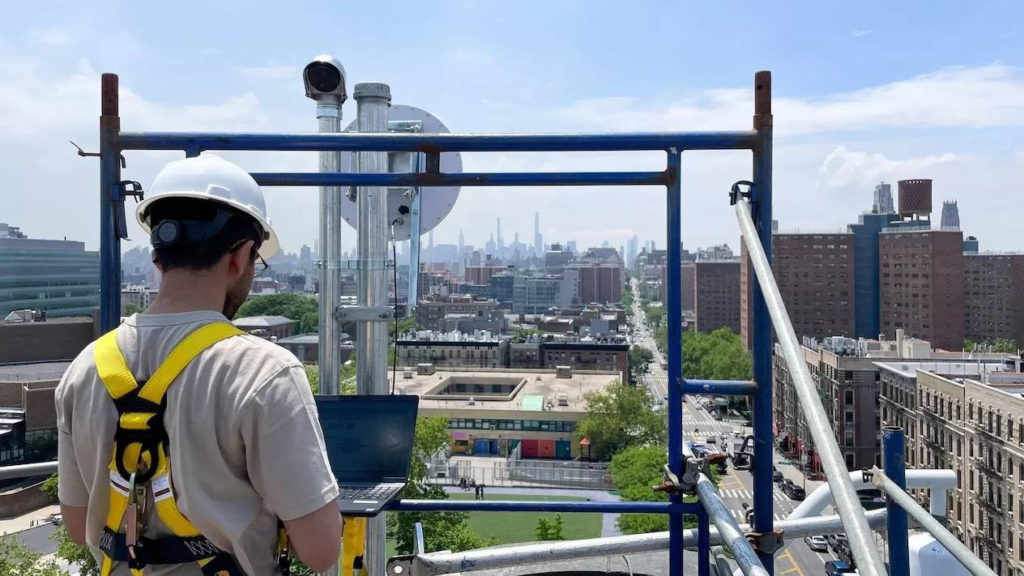
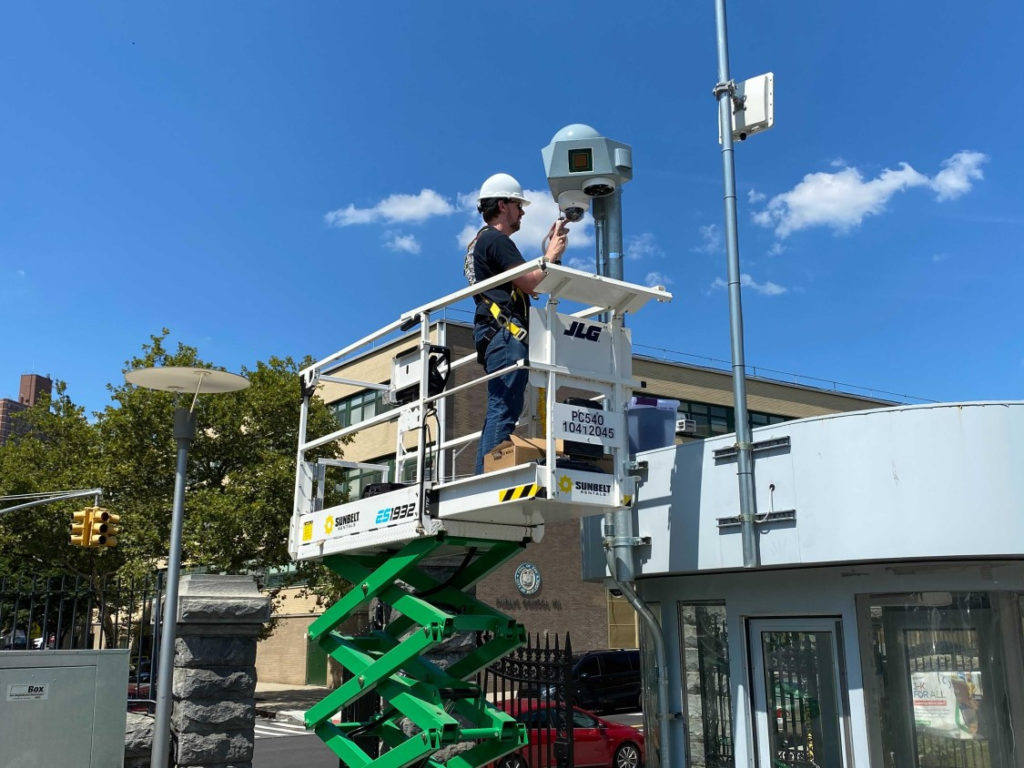
The COSMOS³ project represents a joint effort between Columbia Engineering and the Data Science Institute (DSI), building on years of collaboration. The project will upgrade existing nodes and deploy new hardware integrating multi-band (FR1/FR2/FR3) radios, multi-modal sensing technologies such as cameras, lidars, and radars, and mobile experimental units for testing across dense urban environments. Industry testbed users and academic users from the Computer and Information Science and Engineering (CISE) research community will soon be able to use these new capabilities.
Beyond its infrastructure upgrades, COSMOS³ will continue to serve as a backbone for major national research initiatives and interdisciplinary collaborations. The testbed has been instrumental in advancing projects such as the NSF Center for Smart Streetscapes (CS3) Engineering Research Center (ERC), which is led by Columbia and explores wireless networking and edge AI for urban safety and traffic efficiency, and the Open Radio Access Network (O-RAN) ecosystem, which enables open, programmable, and AI-driven 5G networks. COSMOS has also recently provided infrastructure for connecting Columbia into a quantum network deployed via the NSF National Quantum Virtual Laboratory (NQVL) program and for Rutgers’ AI Testbed, where researchers study machine learning–based spectrum management and autonomous wireless systems.
Researchers will also integrate advanced situational awareness, multimodal sensing, and edge computing techniques developed at the NSF Athena AI Institute for Edge Computing at Duke. Athena, in turn, leverages COSMOS’ open-access data and infrastructure to advance distributed intelligence and real-time multi-modal sensing. Together, these large-scale initiatives underscore COSMOS’ pivotal role as a national hub that bridges AI, networking, and computing–fostering a shared research ecosystem that connects academic discovery with societal impact.
The cameras integrated into the testbed generate rich video datasets that support research on AI-enabled smart intersections, hybrid digital twin development, and experimentation with NVIDIA edge GPU devices for object detection, tracking, scene reconstruction, and higher-level applications.
“COSMOS has been a cornerstone for wireless, optical, and smart-city research in New York City,” said Zussman. “With COSMOS³, we will significantly enhance the platform and allow researchers to study integrated communication and sensing (ISAC), dynamic spectrum sharing, edge AI, and various other domains that could shape future 6G and smart city technologies.”
“By bridging wireless innovation and community participation,” said Kostic, “COSMOS³ ensures that the future of smart cities begins right here in Harlem.”
“It’s exciting to see COSMOS, on which I spent a lot of time conducting research during my PhD studies at Columbia, enter its next phase, and to now be part of this journey as a faculty member,” said Chen. “We’re looking forward to adding these new features to the testbed with minimal energy and compute overhead, and paving the way for NextG wireless and smart city experiments.”
For more information about the COSMOS platform and its ongoing initiatives, visit www.cosmos-lab.org.